Most of what makes a festival possible happens before anyone arrives are trucks, power lines, fuel tanks, snowscooters. The parts audiences rarely notice are also the parts that carry the largest environmental weight. At Tomorrowland Winter, those parts are now doing something different.
Fixed power and biofuel, replacing fossil fuels
Since 2024, Tomorrowland Winter has operated HVO100 and a fixed power, grid. The festival now runs on a fixed power network, supplemented where needed by HVO100, a renewable diesel alternative made from certified waste and residue feedstocks.
Compared to the previous diesel generator setup that powered the festival, this shift has reduced energy-related carbon emissions by an estimated 80 to 90 per cent within the scope of on-site energy generation. Based on the volume of HVO100 consumed in 2025, that corresponds to a reduction of approximately 300 tonnes of CO2e, calculated from metered fuel use and the certified emissions profile of HVO100 against fossil diesel.
From two logistics partners to three
Production transport tells a similar story. At Tomorrowland Winter, all transport carried out with logistics partners Gosselin, Pieter Smit has been powered by 100 per cent HVO-certified fuel since 2025. Every vehicle moving equipment, infrastructure and production materials ran on Hydrotreated Vegetable Oil, reducing CO2 emissions compared to traditional fossil diesel across the production transport scope.
In 2026, a third logistics partner, Ewals, joined the same standard. Production logistics across the three logistic partners now run on HVO100.
Alpe d'Huez shuttle buses on HVO100
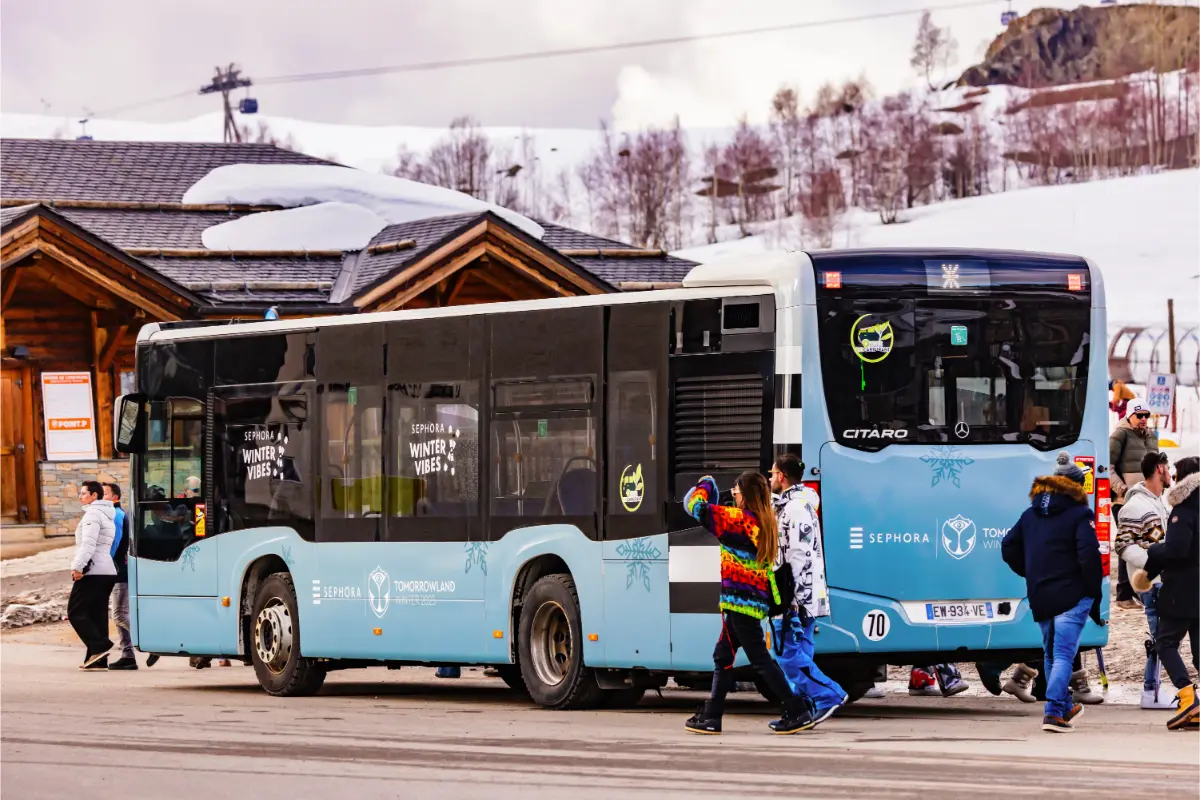
The shuttle buses running through Alpe d'Huez operate on HVO100, a renewable diesel made from waste and residue oils. What started as a choice for the festival now continues across the full ski season, a decision by Alpe d'Huez to keep the change in place long after the music stops.
On the mountain
The shift extends to the slopes. All snowscooters in use during the festival also run on HVO100, bringing the principle of fossil-free operation from the production compound to the most visible vehicles on the resort.
What comes next
From 2027, Tomorrowland Winter targets an on-site energy setup that runs exclusively on fixed power, removing the need for HVO100 generators on site.
The work to get there is extensive: expanding grid capacity at the venue, refining load planning, and aligning with partners on the mountain to make a fully electrified festival operation viable at Alpine altitude.
.webp)
.webp)