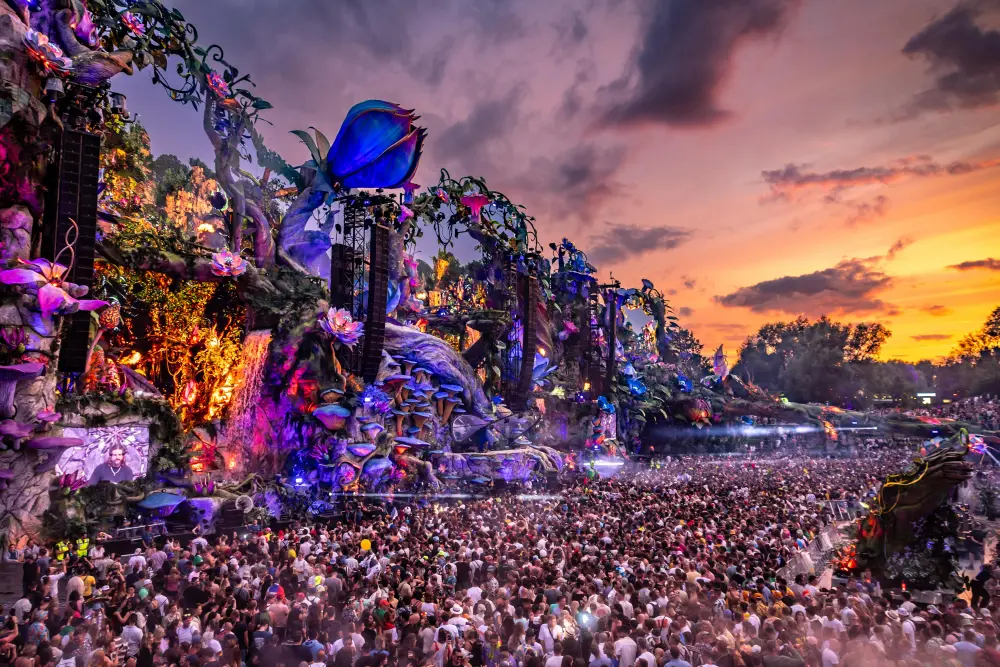
Electricity is essential to the operation of Tomorrowland. From stage production to sound systems and infrastructure, the festival requires substantial energy to function. For this reason, energy use and efficiency remain a key focus within Tomorrowland’s broader sustainability strategy.
Tomorrowland has set a target for all festivals to run on 100% green energy, with all fixed power originating from renewable sources by 2030. Reaching this target requires continuous testing, measurement, and adjustment. There is no single solution for an event of this scale, and multiple energy systems have been assessed over time to identify the most effective approach.
Tomorrowland Belgium’s electricity approach
In earlier editions, the festival relied primarily on decentralised generators, a common practice across large-scale events. These generators were powered by diesel. As energy demand increased, it became clear that a centralised system could reduce overall consumption by creating a more efficient energy flow across the site.
This insight led to a transition toward fixed power infrastructure. Alternative energy solutions have since been tested alongside this system to evaluate their performance and scalability within the festival context.
In 2023, an investment of €500,000 supported the expansion of the fixed power network. This reduced diesel consumption by 44%, as generators were no longer the sole energy source.
In 2024, an additional investment was made to expand the fixed power network of De Schorre. This investment reduced diesel consumption by another 8%. A smart energy plan has been developed, blending generators, battery systems, and the existing grid. This phased approach will be rolled out year by year, ensuring continuous improvement. In addition, an advanced measurement system has been introduced to analyse energy flows, detect peaks, and optimise overall efficiency.
In 2025 the decision was made to switch fossil fuels on the festival site at De Schorre from to HVO 100 or Hydrotreated Vegetable Oils.
Not all tested solutions have proven suitable at scale. Battery systems were piloted in 2023 but were found to be insufficient as a primary energy source for an event of this size. Their value lies in peak load absorption and in supporting further expansion of the fixed power network.
Looking ahead to 2030, additional extensions of the fixed power infrastructure are being evaluated. These measures aim to further reduce reliance on generators. Beyond this phase, Tomorrowland is exploring additional renewable electricity sourcing options and energy trading mechanisms as part of its longer-term pathway toward the 2030 target.
Energy transition within large-scale events is complex and incremental. Progress depends on infrastructure, data, and practical feasibility. The focus remains on measured improvements, transparent evaluation, and scalable solutions.
.webp)
.webp)